The training tips are from my personal experience after more than 40 years of running, finishing seven 50 Milers, dozens of 50K's, who knows how many marathons, as one of the original organizers and 1988 Race Director of the Angeles Crest 100 mile Trail Race, and should be used only by others as something to try at their own risk. If I have learned anything, it is that we are all different. What works for one may not work for another. But as some one with no natural ability who has tried most everything to just be able to finish before they remove the finish line, I've probably made all the mistakes at least twice. A lot of the articles you see in the running magazines, it seems, are written by 3 hour or better marathoners who have no idea what happens to the average first time marathoner who is out there for 5-6 hours and has never used a fast twitch muscle - slower then 8.5 minute mile pace - since high school. There are many articles that just regurgitate what others have written and have little true scientific validity.
Team Couch Potato was a name given by Foothill Flyers Becky McDaniel and Heather Shick so they could make up some unique shirts with a logo after training with me to do their first marathon back in the late 80's. It is not really a formal group or club, just individuals who got together with me to train for their first marathon or ultra - I do love to suck people into new adventures. However, these people are all from the back of the pack who don't do 10 K's any faster than 50 minutes and whose goal is just to finish without injury as well as having fun at it. While some of the running tips below may apply to all runners, the training emphasis is not for the competitive, the mileage junkie, the addicted or faster then 50 minute 10K runners.

Training
It is a real balancing act to get enough training for a marathon or trail ultra while at the same time not getting or irritating an injury as well as satisfy other responsibilities for your time. So I experimented with finding the least amount of training to just finish the race and minimize the probability of injury. Again, this is just to finish, not for a PR or place in your age group, and consists of just endurance training. For a marathon the old one long run per week, starting 3 months ahead and adding 15 minutes per week works great and after training almost 100 people to finish their first marathon, no one has failed. The long runs build to a minimum of 3.5 hours as the longest run 3 weeks before the race as optimum peaking. It almost didn't matter what I ran the rest of each week but was best to get one or two 1 hour runs in just to keep flexible. Sure I used to be a 60 mile plus week mileage junkie and felt guilty if I didn't, but I realized the main topic with those I was running with was all their injuries and what orthopedist or chiropractor they used - some cant run anymore and have had knee replacements. At age 50 (1992) I did not want to go from chronic injury to chronic injury and besides I knew age was not going to let me have any more PR's, so I changed from an addicted mileage junkie to just running for fun ... it is tough mentally, but can be done without a 12 step organization and your body will thank you for it.... honest!
Pick a Race - check out the race review section - set a goal and train toward it. If a couch potato with no running genes like me can do it, so can you.
For a first marathon (26.2 Miles), I suggest the Catalina Marathon in March - What, are you nuts? That's one of the top ten toughest marathons in the US! Yes, that is the rating, but done the Team Couch Potato way of walking the up hills and jogging the downs, it is actually easier on the body than the constant pavement pounding of a relatively flat street marathon like Los Angeles or Long Beach. Besides Catalina has great aid stations, mostly off pavement on single track or jeep dirt roads, very scenic and buffalo. I've done the March Catalina marathon 13 times and the Catalina Eco 6 times - it is one of my favorites plus you will amaze your running friends when you tell them you finished one of the toughest as your first.
First trail ultra (more than 26.2 miles and mostly off pavement) suggestion is the Over the Hill Track Clubs High Desert Ultra 50K/30K in December. If you can do the Catalina marathon, you can do this one in about the same time. This is another well organized event on jeep roads out of the Mojave Desert town of Ridgecrest. If you are not sure you are ready for an ultra but want to try a trail run, do the 30K to get a taste. Many use this 50K as a training run for the Avalon Benefit 50 Mile Trail Race the following month and only have to do one more 4 hr training run in-between.
Pace
With badly worn knees I had to switch from streets to doing all the long runs on dirt trails to keep the pounding down. Then I found that for endurance, biking or swimming was almost as good and they were easier on the knees. There are some nice people doing these cross-training sports and triathlons as well. These alternates allow your sore or injured legs to recover without loss of endurance training. For ultras, I found that I just needed to do at least a 4 hour run or bike every other week twice for a 50K and 4 times before a 50 mile event - mark your calendar backwards alternate weekends starting on the 3rd week before the race. It seems that 4 hours is the magic minimum time you need to endurance train your body for anything up to 15 hours ... at least that is the longest I have ever been out on a race at one time. Nothing new in your body will kick in and have to be trained after 4 hours that has not been effected by training up to 4 hours.
For the trail runs though, the terrain varies so a minute per mile pace does not really apply unless you are one of the top 5% of runners that can hold the same pace up hill as well as down. You must change your thinking from training miles to training hours - your body runs on a biological clock, not a biological odometer. The best you can do is to go by your breathing rate. The conversational rate is still one of the best - If you cannot carry on a conversation, then slow down to where you can. On long runs you will have many ups and downs as to how you feel. Go with how you feel at that moment in time rather than continually looking at a watch and figuring pace. Feel good or starting a down hill? Pick it up. Feel down, ease back, drink, eat, stretch, spend an extra minute at an aid station, make a change and wait for the next up, it will come. Since you should never stretch a cold muscle, I only do it during a run and at the end. Fight the feeling to just tough it out at the same pace because there must be a reason your body is telling you it is not up to par, keep trying things until you find what works for you.
Way back when I was trying to PR my marathon time, I found that 1 mile Fartleks worked best to increase pace for a marathon - my PR is 3:49 at Honolulu in 1984. I did a 10 mile loop where the first mile was just an easy warm up, then at mile 2 into my base pace which was 9 min./mile at that time. At mile 3 I increased by 30 seconds to 8:30 pace, mile 4 back to 9:00 and repeated this base/- 30 second "Fartlek" sequence two more times followed by the last mile an easy warm down. By doing this once or twice a week for 6 weeks I was able to lower my marathon pace and PR under 4 hours. I think this is better for increasing pace at half marathon or longer distances than interval training on a track which is designed more for 5 and 10 K's - I coached intervals on Tuesday nights for the club for 2 years in the mid 80's and it is a great way to concentrate on improving your running style, mechanics and shorter distance speed.

Shoes
Using comfortable running shoes that are at least 1 full size bigger than your street shoes or thumb width between your big toe and the front of the toe box bigger are a must. Trim your toenails as short as possible to minimize getting black toe. As you increase your training run time, improper shoes, inserts, socks, etc., will become aparent by slow to go away soreness and blisters. The longer you run, the bigger your feet will expand and the continuous bumping on the insides of the shoe will give you blisters and black toes if you don't leave enough room. So figure out the best shoes and sox that give you the least problems early in the training. Then buy 3 pairs and rotate them - this makes them last longer by giving them time to dry out and reform the insert cushion between runs. Do not change the type of shoes within the last month before a race.
From running so many years, I did not realize that I had slowly build up a callus or calcium deposit on the balls of my feet. This resulted in getting what I can only describe as a hot foot after running a few hours - very painful. I went to Dr. Dan and Nancy Tinkers free foot exam at the Starting Line running store in Venice Beach on a first Saturday morning to get the right diagnosis. Nancy worked wonders on my orthotics and scooped out a relief depression that spread out the force over the rest of my foot rather than the calcium build area that was pinching nerves. So don't put off finding out what the cause of your foot and leg problems are as your long runs increase in time. Talk to experienced long distance runners, running podiatrists, knowledgeable sales people at reputable running stores like Run with Us or A Snails Pace.

Hydration
This is number one and determines if you will hit the wall or not. I sweat a lot and look like a ghost with all the salt caked on my face and body when I come in. Fluid loss varies with everyone and the weather conditions. If you loose 1% of your starting body weight, you are seriously starting to physically go down hill. Your heart rate will increase 5-10 beats per minute just to keep the same output at the same pace. That means you will burn more energy and loose even more fluid just to stay even. As you dehydrate, your body will start shutting down parts of your body it thinks are not as important to your survival as others. Your legs muscles might be a priority but not your stomach and intestinal function, maybe your sweat mechanism will slow down and body temperature goes up, blood pressure drop; all part of the downward spiral. Consider that the next time you think of not stopping at an aid station or not taking enough fluids just to keep from loosing a few seconds - you will pay many minutes or worse later for not stopping.

You must train as you will run your race. Besides your legs, you must train your cooling system, fluid, food and drug absorption, fat breakdown into blood sugar and the bodies metabolism priorities. You can't not eat and drink on your long training runs and then expect your body to accept it in the race. You must also train your brain to recognize the signals your body is giving you and instinctively react with the right change.
It is best to drink half a pint bottle of fluid at a time rather than continuously sip. A half a bottle will positively trigger the stomach emptying and intestinal absorption mechanism as well as give you a better idea of how much you are drinking. It is easier to remember to drink a half of a bottle worth of fluid every half hour than have sipping gaps caused by distractions on the run course. Stay hydrated, and there is no reason for you to hit the wall. Make a time based hydration plan and stick to it.
Hydration Test
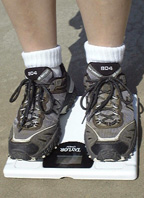
We are all different so to tell how much you need, during a 2 hour or more run, note how many pints of fluid you drank on the run and weigh yourself before and after -YOU MUST DO THIS! For each pound lost, that is one additional pint of fluid you should have drank over that time period. If you are not sure how much to drink, try drinking 1/2 of a pint bottle every half hour. Do the test again about 2 weeks before the big race when conditions are likely to be similar to race day and after adjusting your intake to stay even from the results of the first test. Do this by time, rather than miles since again we are all different and the course and the conditions will vary. In fact, do this test for every long run you do to really get to know your hydration needs under various conditions; you will be surprised.
Most find that they have not drank enough, but some may find they drank too much and gain pounds. You will do your fastest time if you drink what ever it takes to stay even. Not enough can put you in the dehydration downward spiral to hit the wall. Too much can deplete too much sodium and other electrolytes in sweat and urine. If you are hitting the porta-potty often with clear urine, you might be over doing it. The hydration test is the best way to find out how much you have to take in over time to stay even.
What to Drink
Drink plain water or what ever you like to drink most. It is more important to drink and eat what tastes good to you than any fancy formulation or marketing hype sports drink. If the drink doesn't taste good, after a few cups you will probably not drink as much as you should at later aid stations. If what you like to eat and drink is not provided on the race course, stick to the water and carry your own food. Don't try anything unknown on race day or you may be running to the porta potty rather than toward the finish line. Again drink by time rather than miles, your body has an internal clock, not an odometer.

At aid stations, I prefer de-fizzed Coke or beer if they have it on a long distance run. The calories will get into you very quickly with either of these too. Do not drink anything at an aid station that you have not already tried as some sports drinks may not agree with you. Beer is a great recovery drink taken within a half hour of finishing according to a study. Beer is not dehydrating in the practical sense as most have been led to believe. The carbo and alcohol calories will get into your system very fast and be burned up - no you wont get drunk as long as you don't stop running or drink more than 12 oz per hour. This old dehydration urban myth came from studies on skid row winos or Irishmen who drank all their meals. Yes, drinking a 12 oz beer will lower your water balance by increasing kidney function, but only to the extent that you drank 11.2 oz of water instead. So if you are running a hot trail ultra and someone offers you a can of beer vs. a cup of water, you would be better off drinking the whole 12 oz beer than a 4-6 oz cup of water or sports drink. The point is, it is better to drink what you like because you will be inclined to drink more. I had two beers at the Avalon 50 mile, one at the Eagles Nest 38 mile aid station with a buffalo burger and the other was waiting for me at the bottom of Pumphouse Hill (mile 44) that was run out there by a friend and I could really tell the positive difference it made. I also carried two packets of Cytomax which I mixed in one of my water bottles. It is the only sports drink that tastes OK to me and I will drink readily without putting off doing it. Be careful of any fruit juices, the acid content can give you the runs. Bottom line is figure out on training runs what you like and can tolerate.
Salt
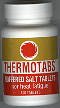
If you sweat or breath, you are losing sodium. When the sodium level in your cells drops below a certain level, the fluid in your intestines will not pass through into the blood stream - osmosis stops. Then you can drink all you want, but the fluid will just sit in your stomach and GI track and slosh around. You will start to feel bloated, lethargic, maybe little shivers down your back....and you are on your way to hitting the wall. Most people hit the wall from dehydration due to low sodium/fluid than running out of blood sugar and energy. I learned this the hard way in the 1992 Ironman in Kona after getting two IV's to bring me back to life. After that I started taking salt tablets - 450 mg Thermotabs - one tablet after every two to three 12 oz bottles of water starting after 3 hours on a cool day and 2 hours on hot days - do not take any more than this ratio of 1 tablet per 24 oz and only during the long run, especially if you have high blood pressure and/or taking medications. Some aid stations will have salty pretzels or chips which help too if you don't have any tablets.
Forget the sports drinks, none of them have nearly enough sodium - 8 ounces of Gatorade only has 110 mg and 50 calories. You would have to drink 175 ounces of Gatorade just to reach the 2400 mg recommended daily intake of salt necessary for a non-runner - therefore taking up to 4 Thermotabs during a long run or race will still be under the minimum daily requirement. Coke has about the same amount of sodium as Gatorade, don't let the name "soda" make you think soft drinks contain sodium, they don't. Check the labels.
Succeed S Caps
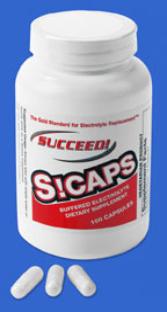
At a Ridgecrest 50K drawing I won two bottles of Succeed S Caps and they worked wonders for me. They contain 341 mg of sodium and 21 mg of potassium, so I have switched over from Thermotabs to these. Take 1 tablet after every 24 oz of fluid. Take any salt per volume of water rather than time. Two many can cause you to over heat. They are only about $20 for a bottle of 100 on the Internet.
At the Avalon 50 Mile, I packed a thermos of Campbell's chicken noodle soup for my drop box taken out to the Little Harbor aid station (aka Whacko Cafe). A can of this soup has 2200 mg of sodium, 150 calories and I drank/ate half going out (mile 22) and the rest coming back (mile 34). Those of you who have seen runners literally rise from the dead after chicken noodle soup at an AC100 aid station know what it does to get you going again - it is the salt getting the fluid into the blood stream again.

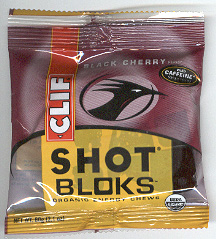
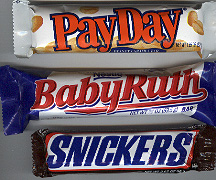 Again, if it tastes good, you will probably eat more when you should. I cant stand to eat more than one of the sawdust sports bars and you do need to get calories into your system. Your liver can get the blood sugar converted from fat when hit with adrenaline but may also take from muscle as well as being slow to metabolize. We all have enough blood sugar for at least an hour before needing more calories in the form of food and drink or breaking down stored fat. And once you start eating and drinking calories you need to keep doing it because the liver is lazy, especially if you are dehydrated at all. At the Avalon 50 mile I took 10 miniature Baby Ruth's candy bars (only 1 oz and 100 calories each) with me and ate 1 per hour after 1.5 hours from the start. Actually I had 5 in my pack and replenished from my drop box on the way back through Little harbor. They are easy to open and don't pull your fillings out in cool weather. In addition I ate and drank what ever they had that looked good at the aid stations. For the first time I felt about the same through the whole 14 hour event. Mary Ann could not believe the difference from past ultras and marathons. For me it seemed that eating at least 200 calories per hour on the run was the right amount to keep the blood sugar level even. Of course, you will have to do the extensive research of checking the total calorie content and taste of the various miniature candy bars - Snickers, Baby Ruths and PayDays are about the same 100 calories per ounce - how bad can that be?