Foothill Flyers Race Reviews
Last update June 10, 2026
Return to: Foothill Flyers Home Page
Run Routes and Maps
Race Reviews
Team Couch Potato
AC100 History
Angeles Crest 100 Mile Trail Race
2026 Event Course and Month Change!
First Saturday in October, Altadena, CA, 5:00 AM Start Saturday Oct. 3rd.
33 hour time limit to get to the finish back in Altadena, 2pm Sunday October 4th.
2026 Race Pace and Aid Station Cutoff Chart
You can track all the runners during the event at AC100 Live.
In 1986, there were only five 100 milers in the world! Now there are over 140. Only six are "point to point." AC100 is the fifth oldest 100 mile endurence run in the world and it's in our back yard!
Ken Hamada, Race Director
AC100 History
Chad Bruce's video of his training runs on the 2024 course:
Start to Mt. Baden-Powell
Islip Saddle to Shortcut Saddle 2025 turns around at Shortcut.
Shortcut Saddle to Red Box
Red Box to the Finish
Application for the runner lottery is on the web site for 24 hrs. from noon on Monday after the event. Applicants are being encouraged to opt to run Solo - no crew, pacer or spectators with a car - to limit traffic on Hwy 2 and thus allowing more entries. See Richard Carne's tips and experience running Solo. All the info is on the Angeles Crest 100 Web site and 2024 Race Book.
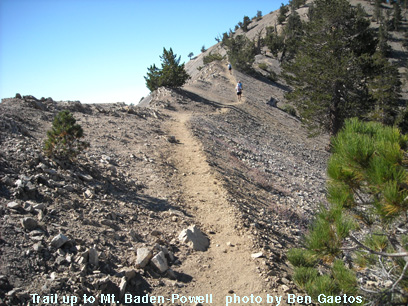
Mt. Baden Powell is the highest point on the AC 100 race course - 9399 ft msl and about 17 miles into the race.
Foothill Flyer alumni Jim O'Brien still holds the course record of 17:35 set in 1989 - read the article from the 2009 Race Book and video.- 1989 AC100 Finishers
Check out the AC100 Course Description starting on page 19 of the 2018 Racebook. There is a lot of information and maps of running the segments between aid stations which are useful even for those wanting some trail training or a good hike in the mountains.
See Bob Adjemains The Angeles Crest 100 Mile Run for the first timers. Another good article on how to train for the AC100 by Kyle Fulmer can be found in Trail Runner Magazine.
You can download past years Race Books, photos and race information from Larry Gassans web site. Read Ben Gaetos 2011 race experience. Race videos: 2013 - 2015 - 2016. 2018 - Rudy Valenzuelas's 2019 race video
.
Some History of the beginnings of AC100 and club involvement
This race was founded by past club members Ken Hamada, Del Beaudoin and Ted Hill as the first trail 100 mile event in Southern California with a few differences to the grandaddy of 100 milers, Western States 100 (WS100) that goes from Squaw Valley Ski lift to Auburn in Northern California. In 1984 about a dozen of us, mostly club members, met at Arnold Gaffrey 's (Sierra Madre Search and Rescue) Insurance office - now Capelli Court Salon - at 51 N. Baldwin in Sierra Madre to start figuring out all the logistics and organization of the event - 1986 AC100 Task List - 1986 AC100 Meeting Notes - 1986 AC100 Finishers
Ham radio was a major factor in getting the USFS to issue a Special Use Permit for the race. Their big concern was evacuating the forest if there was a fire. We were able to convince them that there would be hams at each aid station logging every runner in and out and radioing the data between adjacent aid stations and Search and Rescue - 1986 Ham radio volunteer letters and assignments.
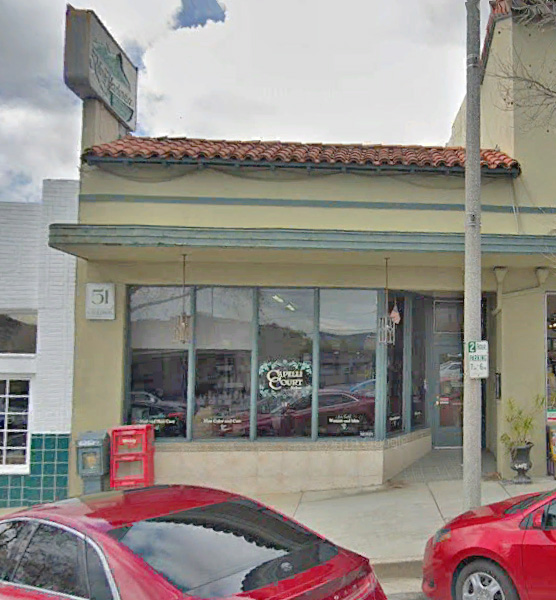
51 N. Baldwin Sierra Madre - Where the hard work of organizing a 100 mile trail race began in 1984.
The original AC100 in 1986 went from Wrightwood to the Rose Bowl. They wanted a tougher and more runner orientated 100 mile trail run. As a tougher trail with much greater altitude gain the finish cutoff was made 33 hours rather than 30 at WS100. Also runners could not be pulled by medical at the aid stations, the runners decide after consultation. Many club members were recruited to help organize and work to make the initial events a success. The club worked both the Chantry Flat and Newcomb Saddle aid stations. See the Oct. 2, 1986 LA Times article.
A paragraph from a task list made for a meeting before the
first AC100 in 1986:
“Need to present AC100 pitch and “trail” slide presentation
at the August second Wednesday meeting of the
Foothill Flyers club meeting. Contact Steve Cunningham
President. Would like the Flyers to put up several tough
night stations.”
It worked, Bill Dickey was the Newcomb Saddle aid station captain and Barbara Basta captained Chantry Flat for the club in 1986. Out of 59 starters, 37 finished or 63%. At the time, AC100 was only the 5th 100 miler in the world. Jack Slater from the club came in second and went on to finish a total of ten AC100's. Other Flyers that ran the first AC100 were Bob Moses, Bob King and John Radich.
Our club operated the Chantry Flats aid station at mile 74 in the race every year until the Bobcat fire forced a course change. It is a very worthwhile and satisfying experience to know you helped a person who has made training long hours for at least 6 months their priority, is physically and mentally exhausted, revitalized by your efforts, to get up and start up the trail to Mt. Wilson and on to finish 100 miles.
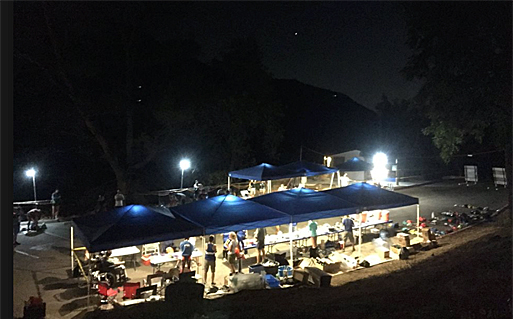
The Foothill Flyers Chantry Flat aid station helps rejuvenate runners all through the night from 6:30pm to 5:25am.
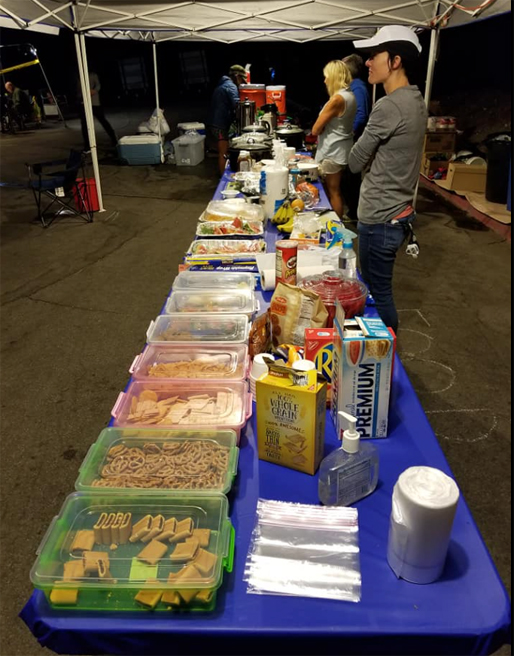
Runners and pacers have a large selection of food and drink. Potato corn chowder is a big hit, and this year, with optional bacon bits sprinkled on top.
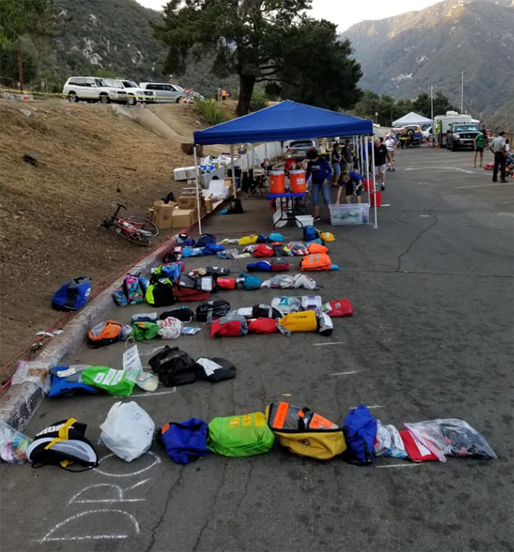
Drop bags are transported from the start in Wrightwood to the aid stations that allow them so runners can replenish supplies, change clothes, change batteries, etc..
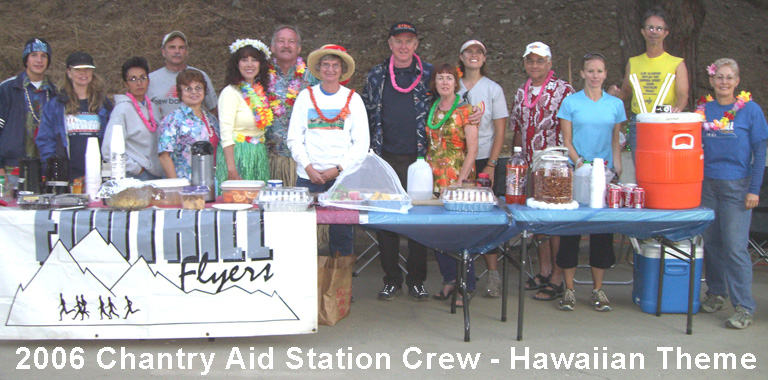
Some of the aid stations have a theme and dress up or decorate for the event. In the past the club has dressed up as Trekkies and Space Aliens, Cowboys and Indians, and for 2010 the theme is M*A*S*H* 4077th.
In 2022 and 2025, the course was an out from Wrightwood to Shortcut and back to Wrightwood. The club worked the aid station at Cloudburst Summit - 7000ft on Hwy 2. 2023 was cancelled. In 2024 the course went back to finishing in Altadena but instead of going to Chantry, it went from Newcomb Saddle, to Redbox then back to climb up the Kenyon-Devore trail to Mt. Wilson and then down the Toll road. The club again worked the Cloudburst aid station. In 2026 the club will be doing the first aid station located at Clear Creek. This is the same aid station the club did for the Mt. Disappointment and Angeles National Forest trail ultras.
New in 2022, the Foothill Flyers Radio Club took over sweeping the course behind the last runner at each aid station in the interests of facilitating runner safety. Each sweep team had at least one licensed radio operator to enable calling in the location and status of a runner found on trail that was not having a good day and needed help from the closest aid station or search and rescue. See the Sweeping AC100 2022, Sweeping AC100 2025 and AC100 Ham Radio web pages.
Angeles Crest 100 Mile Endurance Run - 2001..Reflections
By Hal Chiasson
Most ultrarunning articles seem to focus on winners and winning times. I would like to digress from the status quo and talk in general about the course, including the sections which seemed to give runners the most difficulty. Without taking a survey of all participants, it would be impossible to do this accurately, but by analyzing the locations where people dropped out, we may get a few clues.
In the way of background, this was my 4th hundred miler in as many years, and the 3rd for Angeles Crest.
I just finished doing the stat's on the 2001 AC, including split times for all runners at all aid stations..a very interesting (and labor-intensive) chore. The following are some of my observations: Approximately 150 signed up, but only 118 showed up and started the race, with 64 finishing, and 10 receiving silver buckles for finishing under 24 hours. The finish rate is fairly standard for this course, but it always seems like a disproportionate number of runners drop - the average finish rate is consistently about 55%, no matter what the conditions may be on race day.
This year, for example, was one of the hottest in memory on race day. Temperatures in the lowlands hovered around 100-105 degrees in some areas. This usually translates into a warmer than average day in the mountains...and it was...trust me on this! Last year was a little cooler, but the dry heat and warm breezes made Y2K difficult for many. Race day, 1999 was very warm as well, but not so in 1998. In that year, the weather was nice at first, but by late morning, a storm blew in, and it turned cold and rainy during the night, requiring a mid- course correction on clothing. So what's the lesson to be learned?...track weather conditions as closely as possible for the days preceding race day, but be prepared for anything, because most anything can, and often does happen during the course of a hundred mile run.
On another matter, I was curious as to why and where 54 people dropped out. It turns out that two didn't make it to the 1st aid station (Inspiration Point..mile 9.3) for one reason or another. Perhaps they didn't feel well or encountered some other problem early on.
One runner dropped at Inspiration Point (mile 9.3), but there were no drops at Vincent Gap (mile 13.8). In fact, most of the times coming into IP were very good, and most had reasonably good times coming into VG. The race starts out at 6000' elevation and quickly climbs to over 8000' in the first three miles or so, followed by ups and downs coming into IP. The stretch from IP to VG, approximately 4.5 miles, is relatively easy, but at Vincent Gap (mile 13.8), the real world begins for many, with a four mile climb to the highest point of the race... Mt Baden-Powell, at 9300', followed by ups and downs before the long downhill stretch to Islip Saddle, mile 26. By this point, the runner has experienced the two highest climbs of the race, with Mt. Williamson, the steepest incline yet, greeting you at mile 26. Three more dropped at Islip, and four at Eagle's Roost (mile 31). Perhaps the hottest part of the race is Cooper Canyon (no relation to a lady member of the Flyers bearing the same last name.)
This is a seven mile stretch, split nearly evenly between a 3 - mile mostly downhill and the same distance uphill, topping out at 7000' Cloudburst Summit, mile 38. This has always been a significant milestone for me, because if you reach this point safely within cutoffs, you will have just climbed the four highest peaks of the entire race and should start feeling confident of success. The secret is to reach that point in reasonably good time, and, more importantly, in reasonably good shape.
The importance of this milestone is borne out by the fact that more people dropped out here than at any other checkpoint- nine. It's somewhat of a shame in that the next thirty miles has an elevation drop of 2000 feet or more, which translates into much easier running than the first 38 miles. The five mile jaunt from CB to Three Points (mile 43) is an easy one, yet three more dropped there. I suspect that the drops from this point on were due to a combination of problems including keeping up with the cut-off times, exhaustion (or as one friend calls it "energy management"), lack of proper nutrition/hydration, or injury. The physical stress of the race is cumulative, so a runner may be feeling fine at one checkpoint, but starts to feel weak en route to the next. This ebb and flow of energy can be balanced out by proper intake of nutrients, carbs, and hydration, as well as "backing off" in places to regain the strength necessary to continue.
Four more dropped at Mt. Hillyer, and seven more at Chilao (mile 53). Chilao is another significant milestone, because this is the first aid station which is beyond the halfway point of the race. I normally reach this point late in the day (about an hour or more before sunset), when it finally starts to cool off (but not this year..it stayed uncomfortably warm the entire night and into the next morning.) For some, flashlights are first brought into service here. For many, flashlights are carried from Three Points (mile 43), or Mt Hillyer (mile 49). Those who are strong and fast enough often make it to Shortcut, Newcombe's, or even Chantry before needing them. At any rate, seven dropped at Chilao, four at Shortcut Saddle (mile 59), two at Newcombe's Saddle (mile 68), and eight at Chantry (mile 75).
Chantry is another major milestone, because the runner is now 3/4 of the way through, and (only?) needs to ascend six miles to within a mile or so of the top of Mt Wilson (5700'), jog down an easy three miles to Idlehour (mile 84), then descend two miles down into Idlehour Canyon before climbing a not-too-difficult (but very long) three-four mile climb to the Sam Merrill checkpoint (mile 89). From there, it's downhill the rest of the way, except for a one mile climb from Millard (mile 96) up the Brown Mtn Road.
Two more dropped at Idlehour, and five at the last checkpoint, Millard Campground, almost certainly because of difficulty keeping up with the cutoffs late in the race. Of the five who dropped at Millard, or somewhere between there and the finish, two actually finished, but after the 33 hour 2:00 PM deadline, and therefore were not counted as official finishers, and one had the extreme misfortune of collapsing a mere 200 yards from the finish, where he was removed from the hot pavement and transported by ambulance to the finish..again, not an official finisher.
So there you have it, the good, the bad, and the ugly. One thing is true for sure... the Angeles Crest 100 mile course is no respecter of persons. It doesn't care how rich or poor you are, and it couldn't care less about your age, sex, race, creed, national origin or religion. All it cares about is how well you prepared for it. Those who prepared well are normally rewarded. Those who did not, or otherwise met with injury or other misfortune along the way, can always try again next year. In the end, many friends are made, relationships are cemented, rocks, stumps, hills and mountains are cursed, and many a prayer is thrown up for consideration by the Almighty. These plus countless hours of training are just a part of the total experience of running a hundred miler... not an exercise for the faint of heart or the prima donna...each is both challenged and humbled at one time or another. What matters most, and what cannot be taken away, is the pride and satisfaction of saying "I tried my best and had fun doing it."... There's only one thing sweeter, and that's to be able to say, "I finished it."
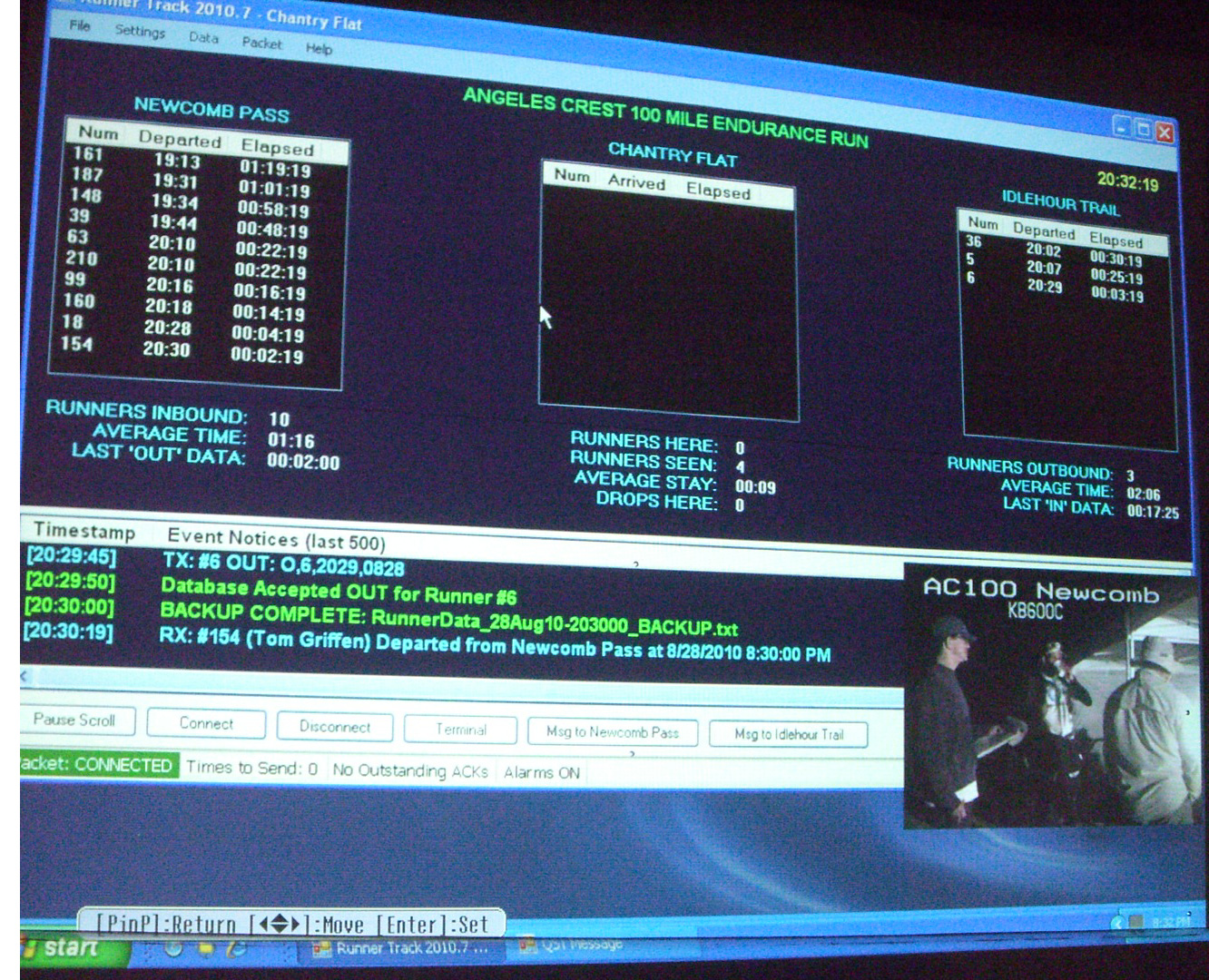
At the Chantry Flat aid station, one of the Ham Radio operators projects the Runner Track system from a computer to a video projector on to a 6x8 ft screen so friends and crew can see the status of their runner between the adjacent aid stations. Note that there are no runners at Chantry, but 4 have passed through and average stay was 9 minutes. From Newcomb, 6.6 miles away there are 10 inbound, and average time so far has been an hour and ten minutes to make the distance. Live video via Ham Radio from the Newcomb aid station is also in the bottom right corner.
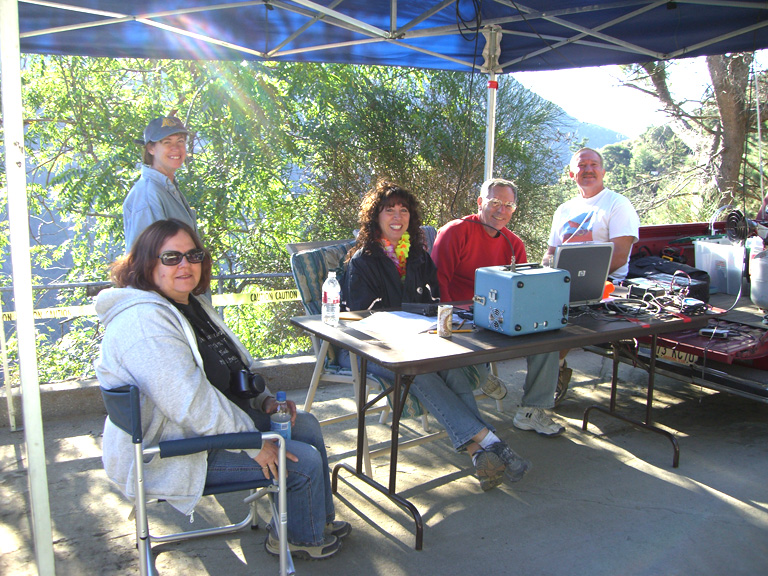
After the last runner leaves before the 5:25 AM cut off time Sunday morning, the ham radio and some of the aid station crew have to wait until the next aid station - Idle Hour 9.2 miles further - or the sweep or trail take down person reports that the last runner is in. All runners entry and exit times are sent via ham radio between the adjacent aid stations so that all are accounted for and no one will be lost or injured for long on trail. Ham Radio works for communicating between aid stations and first responders where cell phones do not in the mountains - See Ham Radio and Trail Running. Members of the Foothill Flyers Radio Club volunteer to sweep the course behind the last runner. If a runner is hurt or lost, they have communication with the aid stations and can respond to the incident sooner than waiting for a report from another runner. Each runner can be tracked during the race on the AC100 Live web page.
 Site Index
The domain of this page is Foothillflyers.org Copyright ©2026 Tom O'Hara. All rights reserved.
Contact: webmaster at FoothillFlyers dot org
Last update June 8, 2026